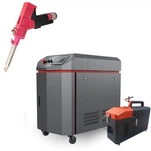
The main differences between fiber laser cleaning and UV laser cleaning are reflected in the following aspects:
1. Working principle and characteristics:
· Fiber Laser Cleaning: Continuous Fiber Lasers work on the principle that the pump light emitted by the pump source is coupled through a mirror into the gain medium, After the pump light is absorbed, the rare earth ions can jump to the energy level and realize population inversion, and finally form a stable laser output. Its biggest advantage is that it can continuously light.
· UV laser cleaning: The short wavelength of the ultraviolet laser and high single photon energy are capable of directly breaking the chemical bond connected between materials. The materials are stripped from the surface in the form of gas or particles. The thermal impact area generated during the processing is small, which has unique advantages in fine manufacturing.
2. Application Areas:
· Fiber laser cleaning: suitable for some large steel structures, pipes, etc., due to large volume and fast heat dissipation, the substrate damage requirements are not high. In addition, with the breakthrough of ring spot technology, ring fiber lasers have been widely used in the field of welding and cleaning, especially for floating rust removal, which can greatly improve the cleaning efficiency.
· UV laser cleaning: It is considered to be the best laser cleaning solution in the field of precision electronics, suitable for various industries and fields such as communications, optics, military, criminal investigation, medical treatment. For example, the 5G era has spawned the market demand for FPC processing, and the application of UV masers has made precision cold machining of materials such as FPC possible.
3. Cleaning Effects and Effects:
· Fiber laser cleaning: In practical applications, continuous fiber lasers are used less, but there are also a small number of applications, which are suitable for occasions where the substrate damage requirements are not high.
· UV laser cleaning: fine "cold" processing technology does not change the physical properties of the object at the same time, the surface of the micro-processing and treatment, suitable for the cleaning of precision devices.
4. Environmental impacts:
· Fiber Laser Cleaning: Due to continuous light, more sparks and soot may be generated in some applications.
· UV Laser Cleaning: The resulting heat affected zone is small. It is suitable for cleaning heat-sensitive materials and does not produce significant thermal damage.
In summary, fiber laser cleaning and ultraviolet laser cleaning have their own advantages, and the selection needs to be comprehensively evaluated according to specific cleaning needs, workpiece characteristics, and cost considerations.