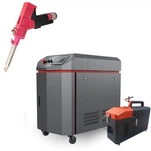
1. CW lasers: These lasers emit laser light continuously, rather than in pulses. They are often used in applications that require a steady laser output, such as laser cutting, welding, and medical procedures.
2. Solid-state lasers: Using solid-state gain media, such as Nd:YAG or Ti:sapphire, they are able to produce high-energy continuous or pulsed laser light. These lasers are often used in industrial processing, medical treatment, and military applications.
3. Gas lasers: Using gas as a gain medium, such as helium-neon lasers (He-Ne) and carbon dioxide lasers (CO2). They can produce laser light of different wavelengths and are suitable for measurement, medical treatment, and industrial processing.
4. Semiconductor lasers (also known as laser diodes): Made of semiconductor materials, they can efficiently convert electrical energy into light energy. They are often used in fiber-optic communications, laser printers, and some medical devices.
5. Dye lasers: Using liquid dyes as gain media, they can be tuned to produce laser light of multiple wavelengths and are suitable for scientific research and certain medical procedures.
6. Fiber laser: Using optical fiber doped with rare earth elements as a gain medium, it can produce high-quality continuous or pulsed lasers, suitable for material processing, military and medical applications.
7. Free electron laser: Using free electron beams instead of gain media to generate lasers, it can produce lasers with a very wide wavelength range, suitable for scientific research.
8. Excimer laser: Using excimer gas as a gain medium to generate lasers in the ultraviolet band, it is often used in micromachining, ophthalmic surgery and lithography.
9. Chemical laser: Producing lasers through chemical reactions, usually used in high-energy output applications such as military defense systems.
Each laser has its specific application field, and choosing the right laser depends on the required laser characteristics, such as wavelength, power, pulse width and coherence.